Other reasons I chose the Canon EOS 750D

For this post, I had to consult my diary. Last year, on 25 Aug 2017, I’d visited the Wex Photographic shop in Norwich, and saw the EOS 750D and 200D. The buttons on the 750D, while not providing enough ‘travel,’ seemed okay once the camera was turned on – but in the event they weren’t okay, I noted that the touchscreen facility was there.

With the 200D, I noted that it was a comfortable, very light camera (even with the 18-55mm kit lens attached), but noted that the d-pad style buttons on the rear were too small – and my fingers aren’t exactly what you’d call ‘big.’

The 750D had 19 cross-type AF points, to the 200D’s 9 AF points – with only 1 cross-type AF point at the centre. That meant more choice when it came to focusing and image composition.

Whereas the 750D could only record video 720p at 50fps or 1080p at 30fps, the 200D was the favoured choice of many reviewers for vlogging, offering Full HD, 1080p 60fps video recording.


Sept/Oct 2017

Shooting ahead a couple of months, my attention was now on which camera to pick. As I don’t want to overcomplicate things, these were my notes:

-Nikon D5600 great. Downside: video quality. Also, 39 AF points, but only 9 cross-type – same as 200D. (D5300 much the same!)

-Pentax – great low-light performance, but cheap build quality, 11 AF points (cross-type?) & video quality not great.

-Canon EOS 750D vs 200D

-Panasonic G7 [mirrorless] – “4k video” but smaller censor than DSLRs, & it’s a mirrorless/CSC = compatible lens availability/back-catalogue?

-Canon 750D – battery grip, lenses available, 720/50 & 1080/30, plus 19 AF cross-type points, 200D only has 9 AF/1 cross-type.

-Canon 800D – 45 cross-type AF points. 1080p 60fps video. Superior to both 200D & 750D. Perfect! BUT, £869 with 18-55mm kit lens.

-Decision made: Canon 750D. For better, or worse…

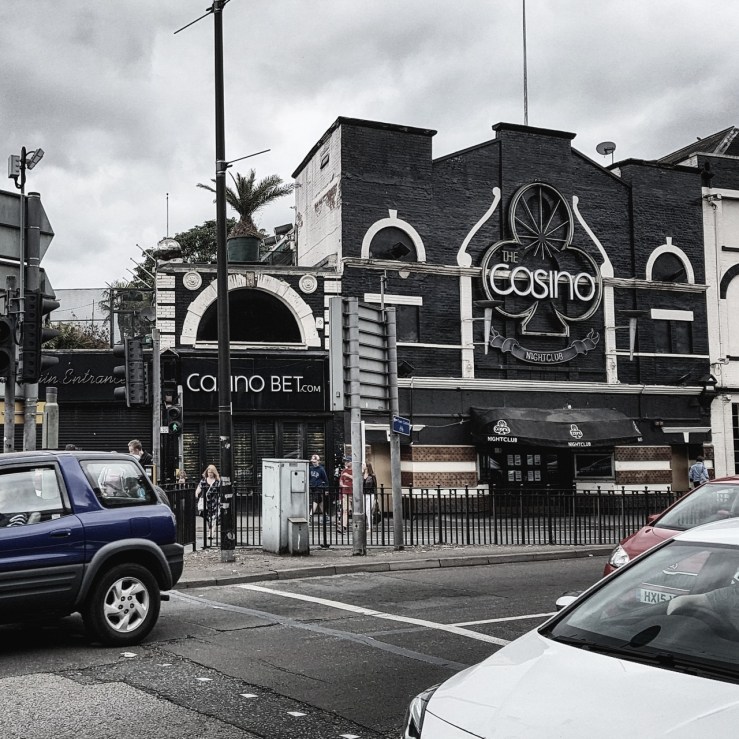
Guildford – Casino Nightclub edit

A recent photo I took in Guildford (June 2018), on my Samsung Galaxy S7, and edited using only Instagram’s edit tools.

Started with a fairly normal photo, but I wanted to really bring out the texture on the top of the building (back bricks). I used the Inkwell b/w filter, but reigned it in a bit, then re-saturated the photo a touch to give it a bleak feel.

I added a touch of shadows, and a touch of highlights – but not too much of either, as the overall aesthetic needed to be harsh with little to no adjustment. It needed to feel real, and spontaneous, while still displaying an air of uniqueness that only comes through editing.

Chris JK

Canon 750D – Wireless Connections

It wasn’t just the focus points or the price that seemed perfect about this DSLR camera, or the Companion app on mobile, it was also the wireless capabilities.

We’ve become so used to sharing photos instantly online, that it’s become a necessity for products to have built-in wireless modes to allow for just that – sharing straight to social media from the camera itself.

After 6 months usage, I have to admit that I’m chuffed with the 750D in this department. I can use Canon’s Camera Connect app (on Android) to remotely control the shutter button, instead of using a separate peripheral (like Canon’s own Bluetooth remote), as well as download the images from my camera to my phone instantly – no need to reach for the SD card adapter or a PC.

But recently, I’ve discovered a whole new way to share to the Internet with my camera. It takes a bit of work to set it all up, but once it’s done, it is possible to share instantly from my camera to the Internet, no phone needed.

To do this, I used the CD software included with the camera – Canon EOS Utility – and connected my 750D to my laptop with the included USB cable. I then edited the WiFi Services, to include Facebook, Instagram, Twitter, Flickr, and Canon irista, amongst others.

I have yet to test this new feature out, but it’s this wireless connectivity which means I can instantly share a great photo with the world, without having to wait until I get home.

This also means I can capture a shot on my DSLR, where the quality of the images is much better than photos taken on my phone, download it to my phone and edit on there – usually, using a mixture of Photoshop, Pixlr, Snapseed, VSCO, Polarr, Skrwt and Toolwiz Photos.

Wireless capabilities allow me to capture great photos and share a moment with the world only a few moments later. It’s quick, easy and effective – just like a smartphone, but with 100 times the image quality.

My DSLR

Up until this point, I’d been looking into so-called Autofocus points, which were dotted all over the camera screen or viewfinder. While both the Nikon’s had them, most of them were single type, not Cross-type.

At this point, I was researching why Cross-type AF points were important, and their advantages over single type AF points. I came to the conclusion that more cross-type AF points would ultimately help me.

  • I should note here that as an amateur, with little to no DSLR experience, nor understanding of the photographic lexis, that cross-type AF points alone does not guarantee better photos. In fact, I’d bet the Nikon’s (D5300 and D5600) can take better photos than the DSLR I eventually chose, but what I wanted was a camera that could take me from simply fiddling with Manual mode (on the mode dial), to fully understanding Manual mode and reaping the benefits.

The Nikon D5300 and D5600 both had 37 AF points, but only 9 of them were cross-type AF points. That, for me, pitted them against the Canon 200D, which also had 9 cross-type AF points. The advantage the Nikon’s had over the Canon 200D was the aforementioned 37 AF points, of which 26 were single type – the 200D had only 9 AF points altogether, of which all were cross-type.

I came to the realisation that, in the long run, it meant the 200D was great for beginners, and while some pro’s have spearheaded it as ‘the’ best DSLR for vloggers, none of them seem to rate it similarly highly on pure still photography. And to me, that said one big thing about a camera I was alrwsy having second thoughts about due to the small physical buttons on the rear of the camera body.

I then started looking at the 750D (or Rebel T6i if you’re in the USA). It looked perfect on paper, with all 19 AF points being cross-type. It was at just the right price, too.

Then I saw the 800D. 45 cross-type AF points. The flair of the 200D with lots of extras. Surely, surely, this was the camera for me?

It wasn’t. The camera was perfect, but the price wasn’t. It was too expensive, and in the end, my budget was more important. I could’ve kept on going, maybe spending a bit more and getting the 70D, or better still, save money and get the 7D… 5D… 1D.

But I didn’t think a more expensive camera would do any good.

I’d heard an analogy, which went along the lines of good camera/crap photographer vs crap camera/pro photographer that seemed to stick in my mind. I could’ve bought the top model, but still be a rubbish photographer; or, I could start at or near the bottom, with a budget or mid-range DSLR, learn the ropes, and become a better photographer than I was before.

The 800D, while perfect, made me re-realise why I wanted a DSLR in the first place: to up my photography game. I was also planning to keep my camera for a similarly long time to my Canon A610 – around 11 years – so it had to be capable and versatile enough to last that long.

So, with that, here’s the cameras I crossed off my shortlist:

  • Nikon D5300 – X
  • Nikon D5600 – X
  • Canon EOS 200D – X
  • Canon EOS 800D – X

So, what was the DSLR camera I went with?

  • Canon EOS 750D

The perfect DSLR for me.

A new camera: DSLR?

I wanted a mirrorless, compact-system camera (CSC) because it offered DSLR features in a compact, point-and-shoot camera body. Ultimate functionality blended with ultimate portability – the best of both worlds.

However, as the CSC market is only just beginning, and although most of the product development is focused on mirrorless cameras as opposed to ageing DSLR’s, CSC’s are pricey. You’re looking at around the £500 mark for a decent budget CSC, whereas my initial, albeit naive budget was around the £300 mark.

After a heck of a lot of in-depth research into DSLR’s and CSC’s, and the occasional look at Bridge cameras, I decided to go for a DSLR – most of the affordable CSC’s I looked at, lacked the viewfinder that a DSLR offers (thus why they’re called ‘mirrorless’ cameras).

Screen time was therefore going to be increased, meaning a shorter battery life and less composing of shots before turning on the camera to take the shot. The biggest con that I found, was that it would cost around an extra £200 to buy an ‘add-on’ digital viewfinder for CSC’s. Alternatively, buy a more expensive CSC with a built-in digital viewfinder. Either way, battery life would still take a massive hit – especially as I would be spending time composing each shot, rather than switching on the camera and snapping straight away. Also, I knew spare batteries weren’t cheap, so that was also another added cost.

I was definitely looking at DSLR’s – the problem was, which one would I get? I didn’t want the absolute budget, entry level model, which for me was a toss up of the Canon EOS 100D or the Canon EOS 1300D.

My next step was to choose DSLR’s which proved to be the top of the budget tier – I shortlisted the newly-released Canon EOS 200D (the follow up to the 100D), the Nikon D5300, Nikon D5600, and Canon EOS 750D.

Wanting all-round capabilities, including half-decent video capture, straight away both the Nikon’s were ruled out. Reviews suggested that video capture on Nikon cameras was a subpar experience, which is why so many vloggers and YouTubers preferred Canon DSLR’s.

(However, I should add that after some limited experience with my dad’s budget Nikon D3100, I’m impressed with the image quality and the Nikon way of doing things – so I’m not ruling out a Nikon camera purchase in the future!)

Coming to a DSLR, I wanted an experience rather than just an upgrade. On mobile, Nikon’s only offering was an app that enabled the download of PDF manuals to your phone. If you’ve just got a Nikon camera and wanted to learn how to use it, you had to fork out more money to attend a Nikon beginners event course. Tut-tut!

Canon, however, have been clever, and have provided us, the public, with the Canon Companion app. Even before I’d purchased a camera, I was learning how to use a DSLR’s basic functions, and how each camera differed from one another.

In the app, I explored both the 750D as well as the 200D – ultimately, it was this, coupled with handling both cameras in the Wex Photographic shop in Norwich, that enabled me to reach a decision.

Then, from outta nowhere, Canon released the 800D…

New blog, new adventure

For every photographer, the act of capturing photos is a creative journey – or, so I’ve read. I’ve also read that it’s useful to keep a blog about your journey into photography.

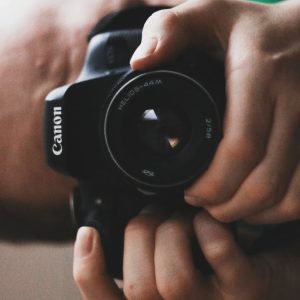
My first experience with a camera was in the mid-90s, with a 35mm fixed-zoom film camera. The first SLR I ever used was my dad’s old Zenit EM, with a Helios 44-M 2/58 lens – however, I never used it to its full potential (as an SLR), and have only ever pressed the shutter button.

Around my 15th birthday, in July 2006, my parents bought me a digital camera – the Canon Powershot A610 – because they were fed up with buying new rolls of film. Apparently, with only 24 exposures per film, I was snapping through them very quickly – “so here’s a digital camera, and here’s an SD card which can store 1000s of images.”

Since 2010, I’ve used a combination of phone cameras, with very little usage of my A610. My phone at the time was a Nokia X2-00, a candy bar style feature phone with a 5mp camera. Pretty good quality, too. I bought a HTC Wildfire shortly afterwards, but haven’t used it a lot since – unfortunately, it became a victim of my experimenting with Android and Flash ROMs. It still works, with CyanogenMod 10 Buzz, but it’s not as great as it was with default Android 2.3.

The device that really revolutionised my camera in pocket game was my iPod Touch 4G. I could never get on with iTunes, or the lack of customisation of iOS, or indeed the fact that a tiny drop often resulted in huge screen cracks and body dents – 3 main reasons why I no longer have it.

But my first smart-‘phone’ was a Nokia Lumia 820 on the Windows Phone 8 OS. It too had a great camera, with touted Carl Zeiss lenses. Again, it still works, and I still occasionally use it, but at the time (Jan 2015) the lack of apps support drove me away to Android. Also, with the recent demise of Windows Phone/Mobile, I fear I may no longer use it at all.

My camera experience then transferred over to the HTC Desire EYE, a mid-range phone with flagship specs. I’ve still got it, and it serves a purpose as my ‘secondary device.’ Almost the same 13MP camera that sits on the rear, also sits atop the front of the phone on the top bezel (the reason the phone was given the name ‘EYE’), the only difference being the apertures – f/2.2 on the rear, vs f/2.4 on the front. The only thing that brought it down as a camera was the response time – it took too long to take a photo.

So onto my most recent experience – a new smartphone as of December 2016, a Samsung Galaxy S7. It’s been great for snapping quick photos, but as with any smartphone camera, photos lack quality and you can’t zoom in on them.

As a photographer, I yearned the return to dedicated cameras, so I started to use my old A610 again last summer. It still worked, until the metal plates in the battery compartment played up. One day, I inserted new batteries, only for it to show ‘Change the batteries’ on the screen. Since a repair of an 11 year old camera was probably going to cost more than the cost of buying a new one, I wanted to take the next step in photography – a DSLR.

After a 6-month search, from initial browsing of the market in June 2017 to making a final decision in November 2017, I settled on a DSLR.